
Oklahoma Police Records
Oklahoma police records are public documents held by law enforcement agencies across all 77 counties. Each county sheriff and city police department keeps arrest logs, incident reports, and booking records that most people can request under state law. Many of these records are searchable online at no cost through the Oklahoma State Courts Network. The Oklahoma State Bureau of Investigation maintains a statewide criminal history database through its online CHIRP portal. This guide covers what police records exist in Oklahoma, where to find them, and how to use the tools available to search online or submit a request.
Oklahoma Police Records Overview
What Oklahoma Police Records Include
Police records in Oklahoma cover a broad range of law enforcement documents. Arrest records are the most commonly requested. Each arrest record shows the name, date of birth, address, race, sex, physical description, and occupation of the person taken into custody. It also lists the cause of the arrest and the name of the arresting officer. These records are maintained by both city police departments and county sheriff's offices depending on which agency made the arrest.
Incident reports and offense reports are a separate type of document. When officers respond to a call, they write up what they found, including the date, time, location, and a brief summary of events. These reports feed into the department's records management system. Tulsa Police uses a system called RCMS and integrates it with body-worn camera data and in-car video. Oklahoma City Police has operated a records repository since August 23, 1910 and now keeps records from all divisions of the department.
Booking records are created when someone enters a county jail. The jail log shows the prisoner's name, date of entry, charge they were held on, and the authority that brought them in. Many county detention centers post live inmate rosters online. The Oklahoma County Detention Center uses the Jail Tracker system at a dedicated portal. The Tulsa County Jail at 300 N. Denver Avenue hosts an online inmate search through the Tulsa County Inmate Information Center.
Other records you may request include jail blotters, radio logs, body camera footage, dash cam video, and crime summaries broken down by type. Tulsa Police keeps its jail blotter for only 30 days before transferring it to the City of Tulsa Municipal Court. Body camera and dash cam recordings are available under the Open Records Act, though agencies can redact parts that would identify minors, active informants, or details tied to open investigations. Requesting just one officer's footage instead of every responding officer typically cuts down on both cost and processing time.
Oklahoma State Bureau of Investigation
The Oklahoma State Bureau of Investigation (OSBI) is the main agency for statewide criminal history record checks in Oklahoma. Its main office is at 6600 N. Harvey Place, Oklahoma City, OK 73116. You can reach them by phone at (405) 848-6724. Office hours are Monday through Friday, 8:30 a.m. to 4:30 p.m. People who walk in during business hours get same-day service.
Two types of background checks are available. A name-based criminal history search costs $15. You provide the subject's name and date of birth, and the system searches three years before and after the birth date you enter. A fingerprint-based check costs $19 and requires a visit to the OSBI lobby. Acceptable payment forms include cashier's check, money order, business check, or credit card. Personal checks are not accepted. Cash works for in-person requests only. If you need a sex offender record or violent offender record specifically, those cost $2 each and are separate from the standard criminal history fee.
The Criminal History Information Request Portal (CHIRP) is the OSBI's online submission system. Create an account, then enter the subject's first name, last name, and date of birth. You can also add known aliases and a Social Security number to make the search more thorough. The $15 fee applies online and is paid by credit card or electronic fund transfer. If you prefer to mail your request, include the completed Criminal History Request Form, your payment, a copy of your government-issued ID, and a self-addressed stamped envelope.
The OSBI also creates criminal history records based on arrest data sent by law enforcement agencies statewide. When a person is arrested, the arresting agency faxes the information to OSBI. OSBI then tracks the case as it moves through the court system and updates the record accordingly.
The OSBI's CHIRP portal is the fastest way to submit a background check request from Oklahoma without visiting in person.
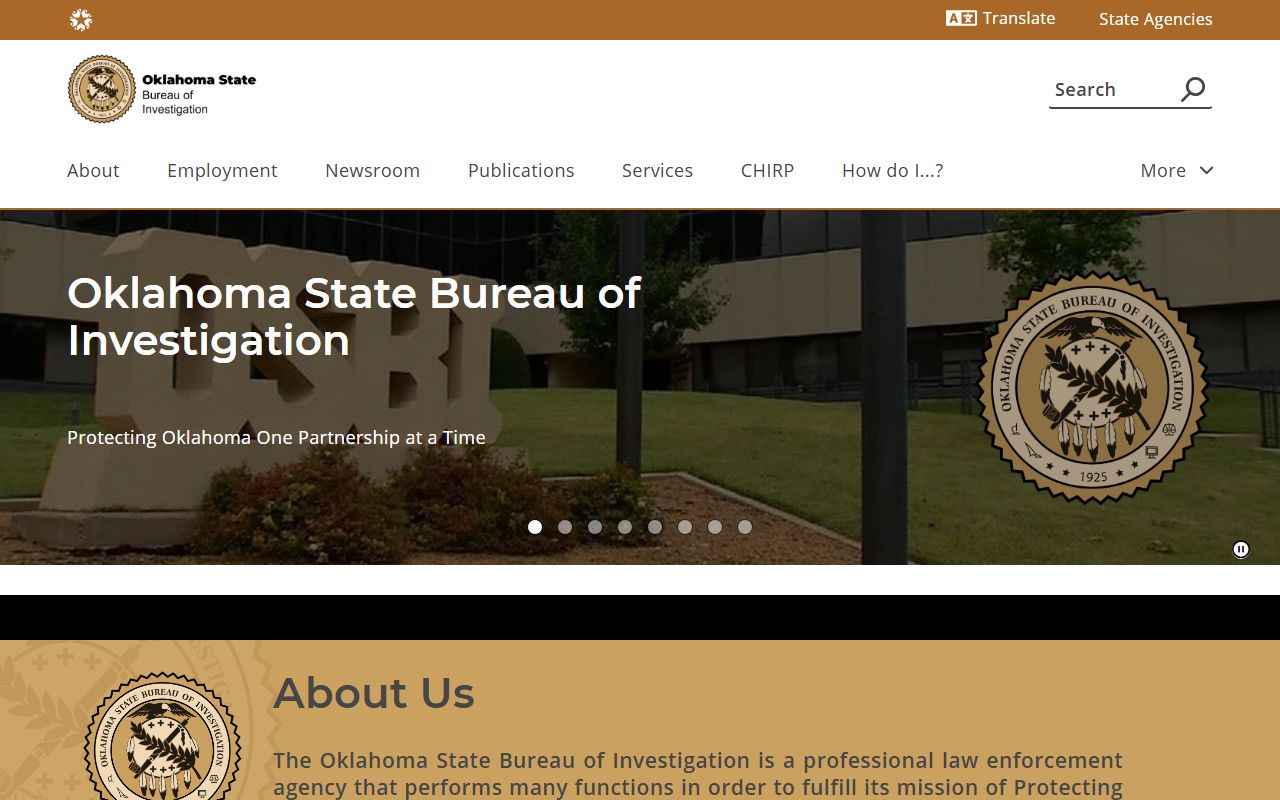
The portal processes payment online and sends confirmation emails, which makes it more convenient than mailing a request and waiting for a response.
The OSBI main website has forms, the current fee schedule, links to related state programs, and information on all OSBI services.
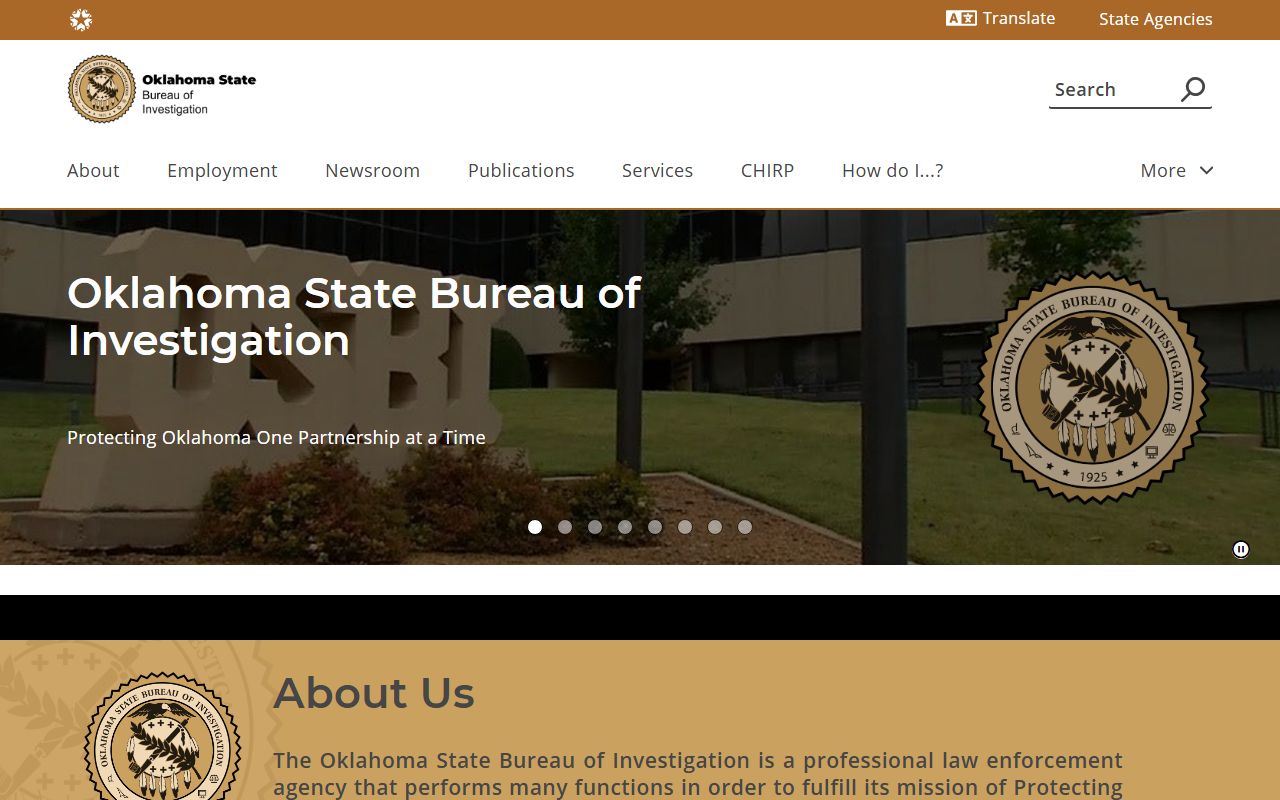
Check the OSBI website before submitting a request to confirm current fees and processing times, since both can change.
Search Oklahoma Police Records Through OSCN
The Oklahoma State Courts Network (OSCN) is the free public portal for court and criminal case records across all 77 counties. It covers district courts, appellate courts, the Oklahoma Supreme Court, and the Court of Criminal Appeals. No account is needed. Search by case number, party name, citation number, or attorney name. Results come back quickly and show charges, court dates, and brief notes from each hearing.
Case numbers on OSCN follow a standard format. CF stands for criminal felony. CM is criminal misdemeanor. TR is traffic. FD covers family and domestic matters. SC is small claims. For a criminal case filed in 2022, the number might look like CF-2022-12345. Knowing the format helps when you already have a case number and want to track it directly. Most cases filed from 1994 onward are in the system. Records older than that require a call or visit to the court clerk's office in the county where the case was filed.
OSCN does not always show complete document images. It gives you the docket, the charges, and the status of the case. For full documents, you need to contact the county court clerk directly or visit the courthouse in person. Some counties let you request copies by mail. Most charge around $1.00 for the first page and $0.50 for each page after that.
The OSCN docket search covers district and appellate court records statewide and is updated throughout the day as clerks enter new filings.
If a name search on OSCN returns no results, try using only the last name and removing any date filters before concluding no record exists.
For cases not found on OSCN, check On Demand Court Records (ODCR), which covers certain district courts that run separate from the OSCN system. ODCR supports online payments for courts that participate in it.
The ODCR portal is a strong backup when OSCN does not return results for a specific county or older case.
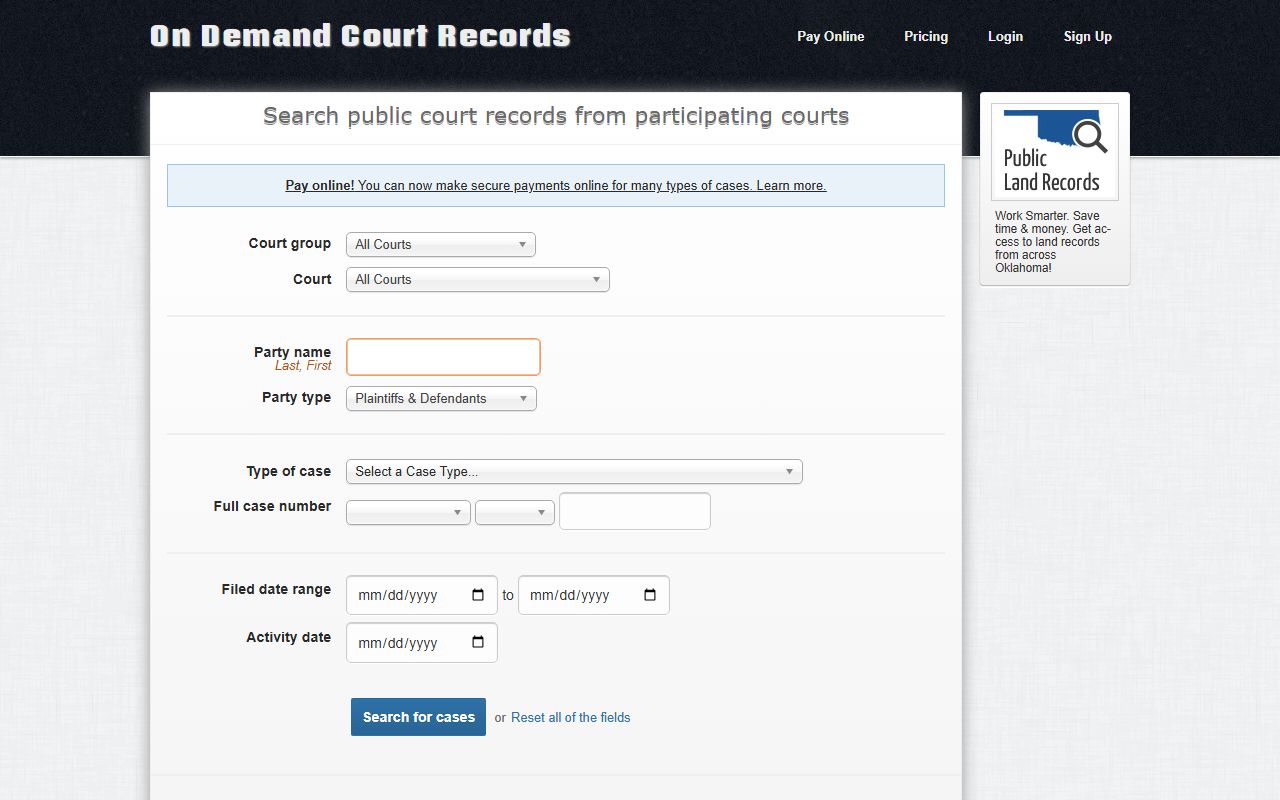
ODCR and OSCN together cover the majority of Oklahoma court case records going back to the mid-1990s for most counties.
County Sheriff Police Records in Oklahoma
Each of Oklahoma's 77 counties has an elected sheriff who keeps law enforcement records for the unincorporated areas of the county and for towns without their own police force. The county sheriff's office is the primary place to look for arrest records from rural areas, jail bookings, active warrant information, and civil process documents. Most county sheriffs now post online inmate rosters that you can check at any time without calling.
Oklahoma County Sheriff operates out of 2101 NE 36th Street, Oklahoma City, OK 73111. The main line is (405) 713-1000. The office is organized into four bureaus: Administrative Services, Judicial, Operations, and Support. The Warrant Squad runs around the clock and maintains a fugitive hotline at (405) 713-1968. The Oklahoma County Detention Center, which is separate from the Sheriff's Office, runs its own Jail Tracker inmate search portal at jtportal.okcountydc.net. Booking information, mugshots, and intake records can be requested from OCDC by emailing records@okcountydc.net or using their online form under the Open Records section of their website at okcountydc.net.
Tulsa County Sheriff is at 6080 E. 66th Street North, Tulsa, OK 74117. The non-emergency line is (918) 596-5600. For public records requests, contact the Public Information Officer by mail or email at pio@tcso.org. Hand delivery of records requests is not accepted. Video and audio requests carry a minimum fee of $55 plus $55 per hour of review and redaction work. For background checks, the Tulsa County Sheriff's Public Services Unit charges $8.00 per check and handles fingerprinting for $15 per card. The unit also processes concealed carry permit applications for Tulsa County residents.
Civil process service fees run $50 per service at both Oklahoma County and Comanche County. Comanche County Sheriff accepts only cash or money order for that fee, not personal checks or credit cards. Most other counties follow similar fee structures set by Oklahoma state law.
City Police Records Across Oklahoma
Oklahoma City and Tulsa have the largest city police records operations in the state. The Oklahoma City Police Department Records Unit began in 1910 and now runs 24 hours a day, 7 days a week. Walk-in hours at 700 Colcord Drive, Oklahoma City, OK 73102, run Monday through Friday, 7:30 a.m. to 7:00 p.m. The records phone is (405) 297-1112. Oklahoma City uses the JustFOIA portal for online records requests.
Oklahoma City Police Department fees run $0.25 per page for letter and legal documents. Development Center records take about 14 business days to process. Requests that need legal review take about 30 business days. Most other records come back in about 7 business days. For digital records like photos or video, the fee is based on the actual cost to reproduce them.
Visit the Oklahoma Department of Public Safety for additional statewide law enforcement resources, including driver records and vehicle registration lookup tools.
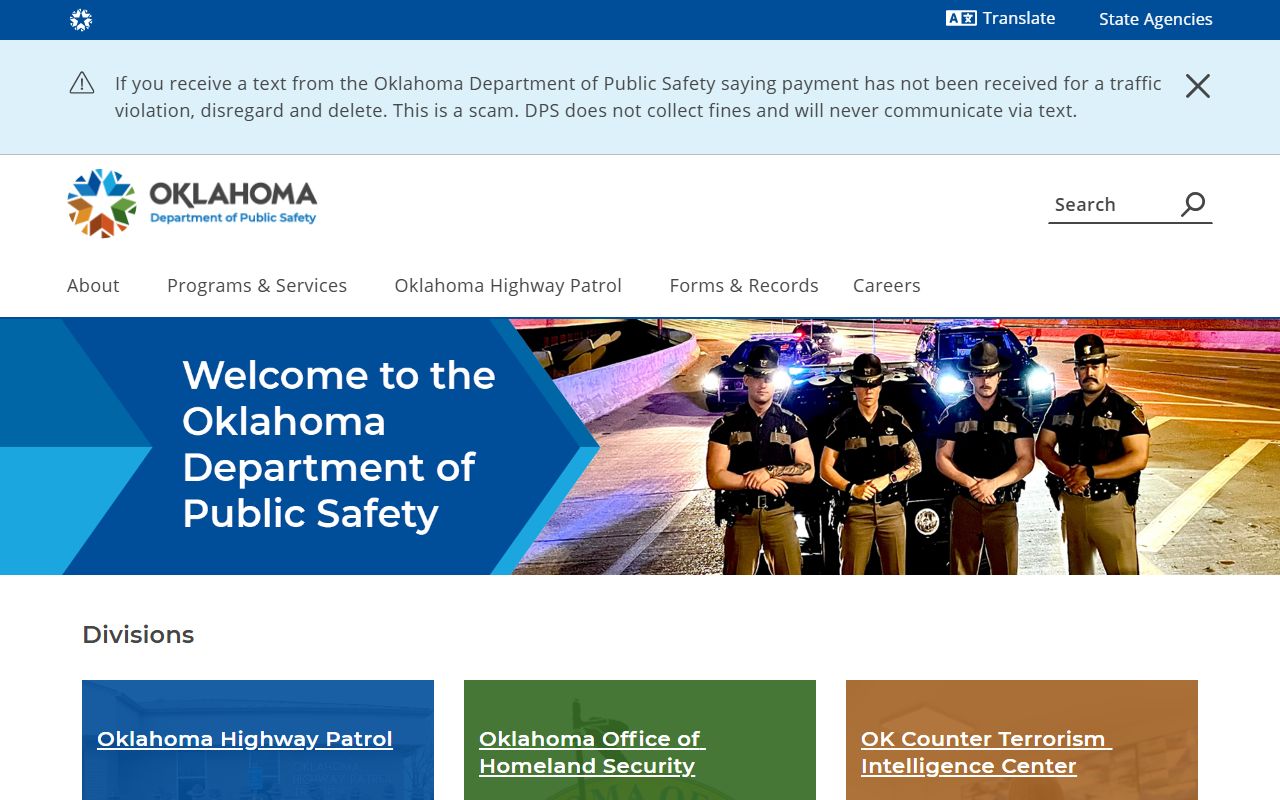
DPS maintains records separate from city police departments but is a key source for driver history, accident reports, and license status checks across Oklahoma.
Tulsa Police handles records through its open records page. Mail requests to Records Custodian, Tulsa Police Records, P.O. Box 1027, Tulsa, OK 74103. The phone is (918) 596-9286. The fee is $3.00 for a record of 10 pages or fewer. Each page above 10 costs $1.00. Crime victims get one free copy of their incident report upon presenting valid ID. Video requests from body cameras require staff to review all footage before release, which drives up the cost significantly.
Smaller city departments follow similar structures. Lawton Police at lawtonok.gov/Records charges $1 per report for individuals with cash only. Shawnee Police at (405) 878-1689 uses the NextRequest online portal. Enid uses GovQA for online submissions. Jenks charges $0.25 per uncertified copy with a $30 per hour search fee for requests that cause disruption. Call the records division for any city before mailing a request to confirm the current process and accepted forms of payment.
Oklahoma Open Records Act
The Oklahoma Open Records Act, found at Title 51 O.S. § 24A.1 through § 24A.22, gives any person the right to inspect and copy government records during regular business hours. You do not need to explain why you want the records. You do not have to be a party to any case. The law covers all public bodies and public officials. Law enforcement agencies cannot refuse a request simply because the requester is not law enforcement or a party to a case.
Under the Act, law enforcement agencies must make specific records available. These include arrestee descriptions with name, date of birth, address, and physical description; facts about the arrest including the cause and the arresting officer's name; conviction information; warrant dispositions; jail registers and booking logs; a chronological list of incidents showing offense, date, time, location, and a brief summary; and body camera or dash cam recordings, subject to allowed redactions.
Certain records are exempt. Juvenile records are confidential under Title 10A of the Oklahoma Statutes and cannot be released to anyone, not even the juvenile or their family. Ongoing law enforcement investigation records, mental health and medical records, sealed or expunged cases, and attorney-client communications are all protected. Requests must identify the records with reasonable specificity. A vague or blanket request can be denied. If your request is too broad, the agency can ask for clarification before processing it.
If a request is denied, you can send written notice to the head of the agency asking them to reconsider. You can also file a complaint with the Public Access Counselor in the Oklahoma Attorney General's office within 30 days of the denial. Agencies must provide prompt, reasonable access and cannot delay responses without cause under Title 51 O.S. § 24A.5.
Note: Requests that are part of active criminal case discovery must go through the Oklahoma Discovery Code at 22 O.S. § 2001-2002 rather than the Open Records Act, and these requests will be denied if submitted through the standard records request process.
Inmate and Offender Search Tools
The Oklahoma Department of Corrections offender search covers anyone currently held in a state prison or recently released. The search is free and open to the public. Enter a name or DOC number to see current facility, offense, sentence details, and projected release date. This portal is useful when someone has been sentenced to more than a county jail term. County jails hold people awaiting trial or serving short sentences, so if the person you're looking for has not yet been sentenced or was given a short local sentence, check the county detention center's inmate roster instead.
The DOC offender search portal is updated regularly and covers all Oklahoma correctional facilities managed by the Department of Corrections.
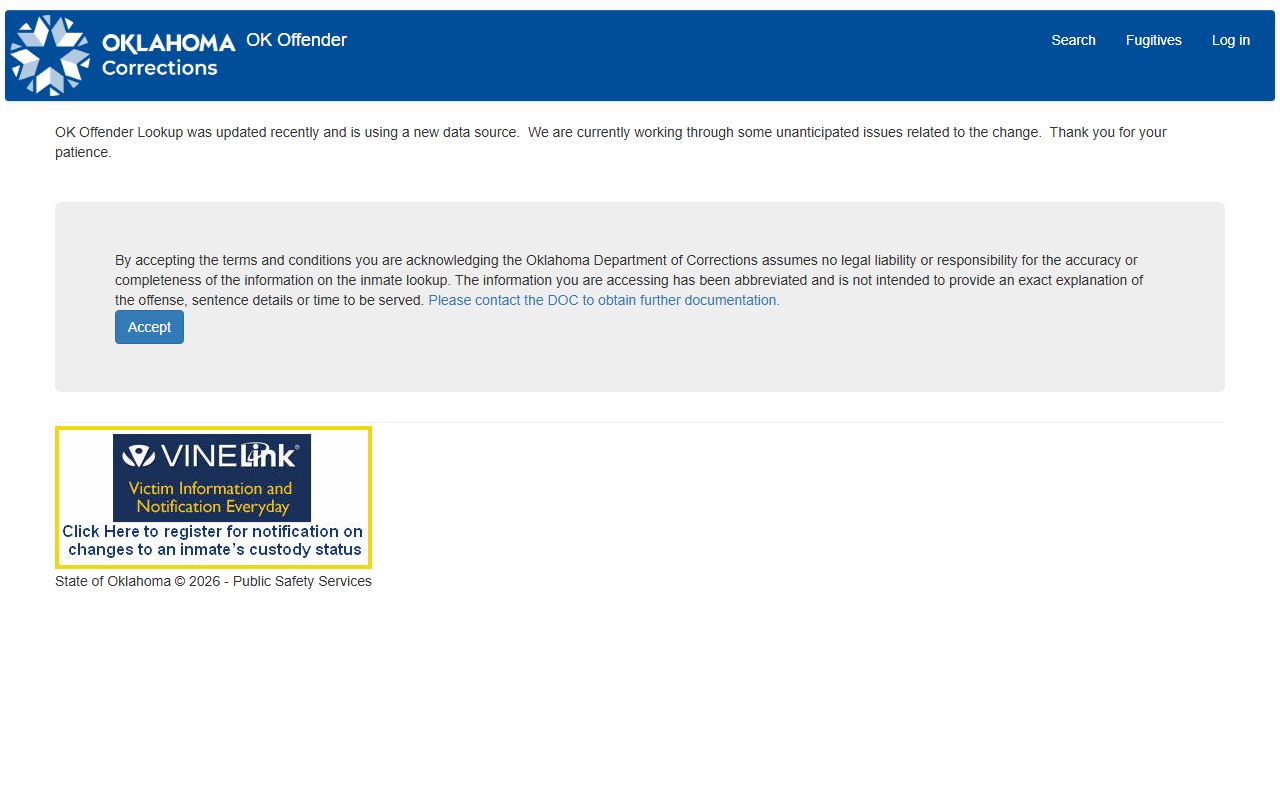
If the person was detained by a city police department, they may be in a municipal jail rather than the county detention center, so it helps to know which agency made the arrest before you search.
VINE (Victim Information and Notification Everyday) is a free automated system that notifies registered users when an inmate's custody status changes, such as a release, transfer, or escape. Oklahoma County Sheriff and most county jails statewide participate in VINE. Sign up online or by phone. There is no charge.
The VINELink platform sends alerts by phone, email, or text message when an offender's status changes in any participating Oklahoma facility.
VINE is most useful for anyone who wants immediate notice when someone leaves custody without having to check the jail roster manually.
Oklahoma Open Data and Related Resources
Oklahoma's public data portal at data.ok.gov hosts downloadable datasets from state agencies, including some that cover law enforcement activity, corrections statistics, and crime trends. The portal is free to use. You can filter and sort datasets to pull information on specific topics without filing a formal records request. It is a good starting point when you need aggregate data rather than a specific person's records.
The Oklahoma open data portal gives access to government datasets that can be downloaded and sorted by topic, agency, or geographic area.
Data sets on this portal may include crime statistics by county or agency, which can help researchers and journalists understand broader trends without submitting individual records requests.
For records related to business entities or licensing that may tie into law enforcement matters, the Oklahoma Secretary of State maintains business records and professional license databases. These are separate from criminal records but can be useful when looking into businesses or individuals with regulatory histories.
The Oklahoma Secretary of State's business records portal covers corporate filings, registered agents, and licensing that sometimes intersects with civil and criminal court proceedings in Oklahoma.
Business record searches here are free and can be done by entity name or ID number without creating an account.
Browse Oklahoma Police Records by County
Each of Oklahoma's 77 counties keeps its own police and court records. Select a county below to find contact details, local databases, and records request information specific to that area.
Oklahoma Police Records by City
Major cities in Oklahoma have their own police departments and records divisions. Select a city to find contact info, fees, and how to submit a police records request in that area.